Thursday, February 25, 2010

Arc de Triomphe and the Eiffel Tower


Arc de Triomphe

The Arc de Triomphe was built in 1836 by Jean François Thérèse Chalgrin. It was commissioned in 1806 by Napoleon, the French Emperor. In 1920, an unknown solider was buried underneath the arc to honor the soldiers who fought for France. This was a symbol of victory for France and Germans and the Allies, both who marched through the arch after victories as they entered Paris. The names of the 128 battles of the 1st French Republic and Napoleon’s Empire are written on the walls under the vault together with the names of the generals who took part in them. Today, the Arc de Triomphe served as a tourist spot. Inside, a small museum documents its history, architectural design, and construction. The price of admission includes entrance to the top of the arch and from the roof, spectacular views are yet to be seen!

Questions:
1. Who built the Arc de Triomphe?
2. In 1920, where was the unknown solider buried?
3. What is the Arc de Triomphe a symbol for?


Eiffel Tower
The Eiffel Tower was built in 1889 by Alexandre Gustave Eiffel. It was built for the International Exhibition of Paris of 1889 in which it commemorated the centenary of the French Revolution. King Edward VII of England opened the tower. The Eiffel Tower was designed to be an observation tower and tourist attraction. The purpose of building this structure was to make it known to the world about the advancement of technology and beauty in France. Also, Eiffel Tower was used as a radio transmission tower. Many radio transmission experiments have been performed atop the tower. The Eiffel Tower still stands today as one of the world's most famous structures of all time. Upon its opening, two major elements contributed to the Tower's becoming an icon: size and shape; Today, in modern society, the Eiffel Tower has been the most visited site in France for at least 40 years. Approximately half of all visitors and tourists come to Paris and actually climb the Tower. It is also one of the most popular souvenirs bought in Paris.

Questions:
1. Who built the Eiffel Tower?
2. How tall is the Eiffel Tower?
3. What was the purpose of building the Eiffel Tower?

Work-Cited

“Arc de Triomphe de l'Etoile.” Online: Discover France. 1997. 25 February 2010 .

“All you need to Know about the Eiffel Tower.” Online: La Tour Eiffel. 2008. 25 February 2010 .

Arc de Triomphe

Arc de Triomphe

Arc de Triomphe, Paris

The Arc de Triomphe was built in 1836 by Jean François Thérèse Chalgrin. It was commissioned in 1806 by Napoleon, the French Emperor. In 1920, an unknown solider was buried underneath the arc to honor the soldiers who fought for France. This was a symbol of victory for France and Germans and the Allies, both who marched through the arch after victories as they entered Paris. The names of the 128 battles of the 1st French Republic and Napoleon’s Empire are written on the walls under the vault together with the names of the generals who took part in them. Today, the Arc de Triomphe served as a tourist spot. Inside, a small museum documents its history, architectural design, and construction. The price of admission includes entrance to the top of the arch and from the roof, spectacular views are yet to be seen!

Questions:
1. Who built the Arc de Triomphe?
2. In 1920, where was the unknown solider buried?
3. What is the Arc de Triomphe a symbol for?

Jeffrey S. Witter

Europe Interim Project


NOTE: I could not upload my powerpoint with the images, so here is a link to download it:

http://rapidshare.com/files/355845146/Main_Sights_In_London_Pics.ppt.html

3 Main Sights of London

Trafalgar Square/Nelson's Column

During the course of the 18th century, Britain truly became an imperial power. Although it lost the War of Independence, Britain still had a great many colonies. In order to guard these colonies and to provide a way to get to the colonies, Britain built up a huge navy during the latter half of the 18th century. However, the strength of this navy was put to the test in 1805. France and Spain allied their fleets together off the coast of Cape Trafalgar, Spain to do battle with the English Navy. Although heavily outnumbered, the English Navy overwhelmed the Spanish and French forces and won a major battle of the Napoleonic Wars. The defeat of the French and Spanish was mainly due to the leadership of Horatio Nelson, a British Admiral who used unconventional battle techniques to defeat the French and Spanish. Although he was killed by a sniper during the battle, Nelson became arguably the most famous ever British Admiral. In the 1840s, Nelson's Column was erected in the middle of Trafalgar Square, which had recently been redesigned by architect John Nash. The Column is 185 feet tall, and at the top has an 18 foot tall statue of Nelson. Until recently, Trafalgar Square was known for its wild pigeons, but a few years ago feeding pigeons was outlawed, and the London Government used hawks and other questionable methods to rid the area of the pigeons.

Number 10 Downing Street

Number 10, Downing Street is the British Equivalent of the White House. The Prime Minister and his family have lived at Number 10 since the Early 18th Century. It is near the Ministry of Defence and other important governmental buildings. Typically foreign heads of state visit here for a photo with the Prime Minister (Currently Gordon Brown.) Important meetings In almost all pictures of Number 10, you can see British Policeman (or bobbies as they are called) standing guard outside of Number 10. Although Number 10 was damaged by bombs during the German Blitz During World War II, it did not take any direct hits, and consequently was not destroyed. In 1991 it was Damaged when the Irish Republican Army fired a mortar at it from a van.

Houses of Parliament/Palace of Westminster

The House of Parliament is where the British Parliament meets to make laws and modify old ones. It's American equivalent is Capitol Hill, where the American Congress meets. The first meeting of the British Parliament was in 1265, and gradually as the political system in Britain changed from a monarchy to a republic, parliament gained more power. The original building in which parliament met in was destroyed by fire in 1834. In 1870, a new Houses of Parliament was constructed, in what is called the “neo-gothic” style. There are 3 towers in the Houses of Parliament, Victoria Tower, Central Tower, and the Big Ben or Clock Tower, which overlooks the Thames River. Unlike in the United States, there is no separation of the three branches of government. The Prime Minister is also a member of Parliament, and so the Prime Minister is often seen talking about new laws. Sometimes the Queen comes to Parliament to give a speech, but the Queen does not take a political stance, so her speeches are usually non-partisan and mainly ceremonial.

Now Answer Me These Questions Three!

1)What happened to Admiral Nelson during the Battle of Trafalgar?

2) What is the name of the current Prime Minister living at Number 10 Downing Street?

3) How many towers are there in the Houses of Parliament?

Works Cited Page

Steves, Rick. London 2010. New York: Avalon Travel, August 2009.

“London.” World Book Encyclopedia. 2008 Edition.

Unknown Author

“Trafalgar Square-A Brief History”

Online: London.co.uk

Published 2009

Viewed 2/21/10

http://www.london.gov.uk/trafalgarsquare/history/index.jsp

Unknown Author

“The Battle of Trafalgar”

Online: British Battles

Published 2010

Viewed 2/21/10

http://www.britishbattles.com/waterloo/battle-trafalgar.htm

Unknown Author

“Houses of Parliament”

Online: A View on Cities

Published 2010

Viewed 2/23/10

http://www.aviewoncities.com/london/housesofparliament.htm

London Eye


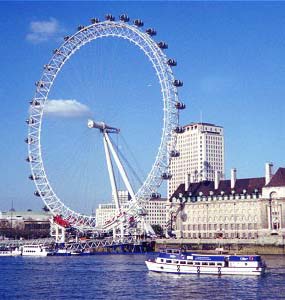
In 2000, the world’s largest observation wheel, the London Eye, was opened for people to observe 135 meters above London. This landmark was designed by the architectural couple, David Marks and Julia Barfield. They designed the London Eye for a competition of making a landmark for the new millennium. The London Eye was made in over a year and a half. It needed over 1700 tons of steel and more than 3000 tons of concrete for the base. The capsules within the London Eye provide enough space for twenty-five people to enjoy the circular tour of the London Eye. Each capsule is eight meters long and weighs 500 kg. Moreover, the London Eye consists of a 25 meter spindle that is connected to the rim, which has a width of 122 meters.
When riding the London Eye, it takes about thirty minutes to complete the whole tour. The ride is slow so that people are able to enjoy the stunning view of London. Since the capsules are made of glass, passengers have a 360۫ view. People are able to have exquisite sights over Buckingham Palace, St. Paul’s Cathedral, the Houses of Parliament, Westminster, Battersea Power Station and beyond.
The London Eye was made only as a temporary display, but fortuitously, it became permanent because of its popular feature, and now tourists like us are able to experience this amazing overlook of London.

Questions:
Why was the London Eye designed?
If each capsule weighs 500kg, how much would it weigh in pounds?
Why is the London Eye still present now?

Sources:
“London Eye.” Online: A View on Cities. 12 February 2010.
< http://www.aviewoncities.com/london/londoneye.htm>.

London. China: Lonely Planet Publications: 2006.
History of Paris-

Paris (known as Lutetia or Lutece in ancient times) is more than 2,000 years old, and the first people that settled there created a fishing village in the river (what it is called now), Ile de la Cité. This happened between 250 B.C. and 200 B.C., and from then on, civilization developed. In 52 B.C., Paris was conquered by Julius Caesar and was made a stronghold for the Romans up until the Middle Ages. When that time came, Count of Paris Hugh Capet became the king of France, and Paris became the national capital under his successors, called the Capetians. In 1789, the people of Paris stormed the Bastille which was like the spark at the beginning of the French Revolution. During the Franco-Prussian War in 1871, the city was besieged by German troops for four months. After the soldiers left, a Commune of Paris was created by the French radicals. From 1940 to 1944 during World War II, German troops occupied Paris once more.

Sommers, Lawrence M. The New Grolier Multimedia Encyclopedia, Release #8, ©1996.

Basilique Sacré-Coeur (Basilica of the Sacred Heart)-

This Roman Catholic church is located in Montmartre, the highest point of the city of Paris. It is mostly remembered for when the city's patron, Saint Denis, was martyred there. Supposedly, after beheading, Saint Denis picked up his head and carried it north.This basilica was created after the Franco-Prussian War and after the forming of the Commune. It was "planned as a guilt offering and a vote of confidence to cure France's misfortunes." It was a place which encouraged prayer to the "Sacred Heart of Jesus," which is also the name of the cult that encouraged the prayers after becoming popular in 1873.

Hayes, Holly. "Sacré-Coeur Basilica, Paris." Online: Sacred Destinations. 23 August 2009. 24 February 2010. http://www.sacred-destinations.com/france/paris-sacre-coeur